
Technology: The New Age of AI in the Life Sciences
With big tech investing hundreds of billions of dollars into artificial intelligence (AI) in recent years, the technology will likely affect almost every aspect of life on Planet Earth in ways that the human mind has yet to even fathom.
AI is no doubt a crucial step towards enhancing not only orangutan conservation but also conservation in general.
“We are looking at a future where technology is becoming all-encompassing and enhances almost every aspect of our lives. So why not our conservation work too?” says Donna Simon, Orangutan Conservation Manager for the Sabah Landscapes Programme in WWF-Malaysia (World Wide Fund - Malaysia, 2023).
In the world of animal welfare and conservation, the technology has already been implemented in various ways.
OlmoEarth, developed by the nonprofit Allen Institute for AI, is a platform that integrates multiple AI models (10 terabytes of observational environmental data), enabling researchers to analyze large data sets by customizing models on the platform (Kindangor, 2026).
The Airbus Foundation and the Connected Conservation Foundation (CCF) recently announced the winners of their “Satellites for Biodiversity” grant, which now uses higher-resolution satellite imagery to aid conservation efforts. According to Sophie Maxwell, CCF executive director, Airbus has developed AI and machine learning algorithms that help enhance images to be “sharper, more detailed…and exciting development,” adding that this would allow “field teams to extract finer insights than ever before” (Sabillo, 2025).
“These projects focus on critical ecosystems and habitats that play a vital role in supporting endangered species, preserving indigenous cultures and livelihoods, and addressing climate resilience,” Maxwell said (Sabillo, 2025).
Wildlife Management
India’s Assam state is renowned as a hotspot for human-elephant conflict, as food shortages over the last two decades have pushed elephants into villages, resulting in numerous human and elephant deaths. In response, engineer-turned conservationist Seema Lokhandwalla has created an AI-powereded device that detects elephant vocalizations and automatically respond by playing sounds, such as tiger roars, which drive herds away (Raman, 2025).
Regarding primatology, activities such as mining, agriculture, urbanization, damming and logging threaten the habitats of great apes, as they have shown resilience to these disruptions by adapting their behavior, including crop raiding and changing nesting sites, a new study finds (Mpaka, 2025). But while such adaptations facilitate their short-term survival, they remain vulnerable in the long term.
“Understanding these adaptive behaviors is essential for developing effective conservation plans that mitigate the risks posed by anthropogenic pressures,” says Rachel Ikemeh, co-vice chair for Africa at the Primate Specialist Group of the IUCN, the global wildlife conservation authority (Mpaka, 2025).
Conservation
As deforestation is one of the primary challenges for conservation efforts, a real-time alert system has been developed by a deforestation tracking platform, Global Forest Watch, which deploys AI models to classify alerts based on their cause, from agriculture, to mining and wildfires. The platform plans to expand the system to include nonforest ecosystems, as well (Kindangor, 2025).
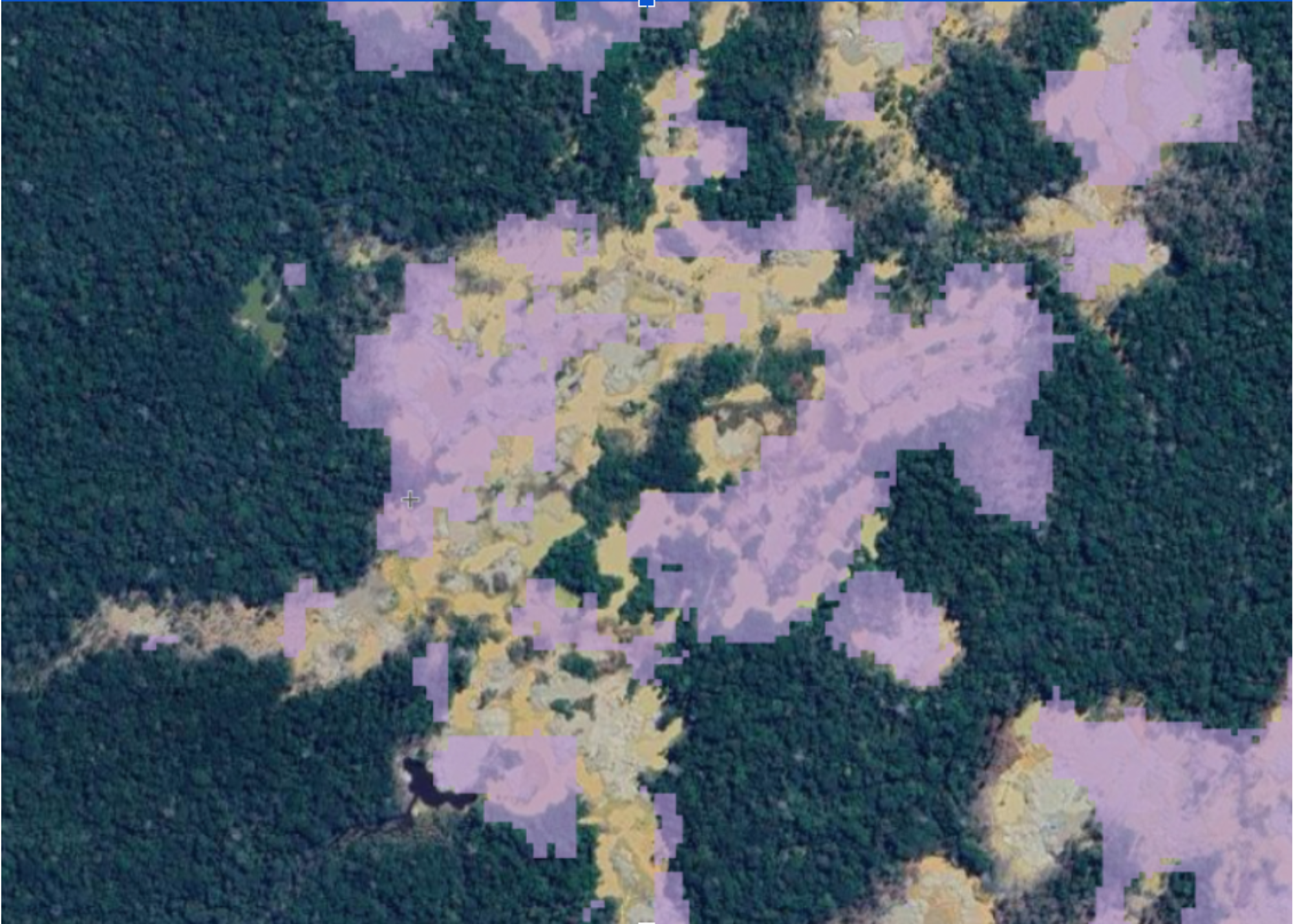
Data shows deforestation caused by mining activities. Image courtesy of Global Forest Watch and Google Satellite Basemap.
The nonprofit Rainforest Connection also conducts biodiversity monitoring using Arbimon AI to transform forest sounds into actionable insights, enabling them to to intercept illegal loggers and poachers, detect invasive species, and trigger timely interventions, which is proven to be valuable for protected area design and reforestation strategies (Rainforest Connection, 2026).
Ethology
Researchers are also reinventing how they study primates in the wild, using AI. What began with Jane Goodall’s research notes has evolved into thermal cameras and deep-learning AI that is able to identify chimpanzees and decode their social structure and spot Brazil’s elusive muriquis via drones above the trees (Fonseca, 2025).
AI technology is now able to take on the images from drones, giving researchers the ability to count and assess orangutan nests from these images. This potentially reduces the time, labour, and cost of such work significantly, as orangutans are very difficult to track in the canopy of the dense rainforest. A recent study shows that an AI model was able to track 1,800 aerial images in under an hour with 98% precision (Sumantran Orangutan Society, 2026).
It is towards this goal that WWF-Malaysia recently collaborated with Universiti Malaysia Sabah to develop an AI technology that can automate orangutan data collection, marking the first step in exploring the world of AI for orangutan conservation. For example, such analysis will assist scientists with understanding the attributes of orangutan nests and how they differ between individuals or populations (World Wide Fund - Malaysia, 2023).
“We can also examine how the nests are used over time, how long they last and how they change with weather patterns. By identifying common patterns in nest construction, we can better understand orangutan behaviour and their relationship with their habitat,” says Amanda Amran, a Computer Science PhD student from Universiti Malaysia Sabah who is currently working on the project (World Wide Fund - Malaysia, 2023).
Scientists also have developed AI models to recognise behaviours of apes in the wild (University of Oxford, 2021), as many believe that AI is proving very beneficial regarding facial and behavioural recognition. “Observing primates by eye and recording everything by hand is a fatiguing and error-prone process…I started using technology to overcome some of these challenges…I use hidden surveillance equipment enabled by AI: small cameras and pressure/motion sensors embedded within tasks,” says Dr. Fay Clark (American Society of Primatologists, 2026).
The authors of a 2023 research article published in the British Ecological Society believe that their automated framework will be very useful to ethology and conservation, “enabling the investigation of animal social behaviour from video footage at large scale, low cost and high reproducibility” (Schofield et al., 2023).
“Using camera trap and direct video recordings, we train action recognition models using audio and visual signatures of both behaviors, attaining high average precision (buttress drumming: 0.87 and nut cracking: 0.85), and demonstrate the potential for behavioral analysis using the automatically parsed video. Our approach produces the first automated audiovisual action recognition of wild primate behavior, setting a milestone for exploiting large datasets in ethology and conservation,” says the authors of a 2021 research article in Science Advances (Bain et al., 2021).
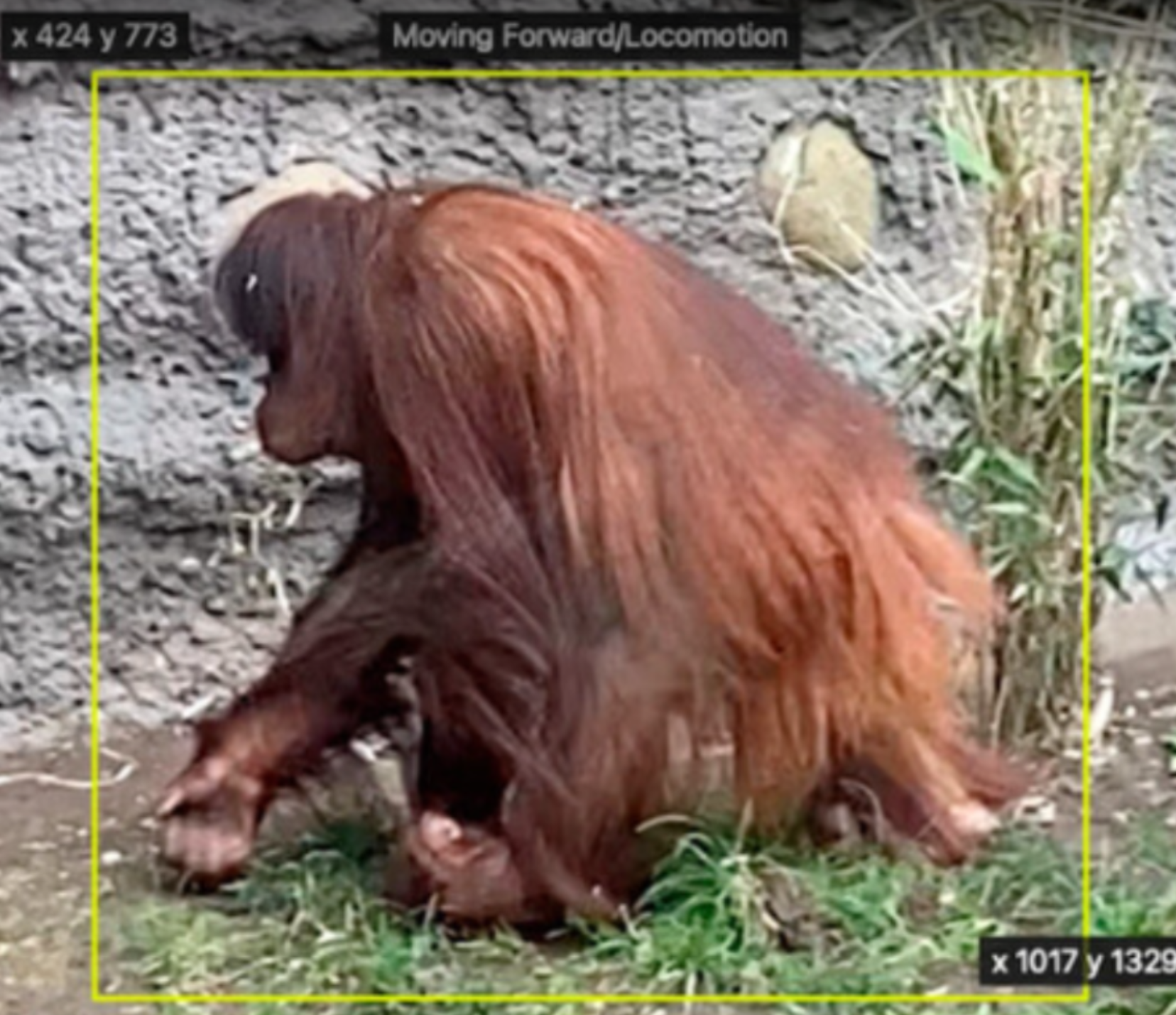
The yellow label box specifies the orangutan’s location and labels the specific behavior with the exact coordinates. Image courtesy Gammelgard et al., 2024.
Another recent study used AI to analyze the long calls of individual orangutans and how they communicate, although there is still much to learn. “Orangutans may possess a far greater repertoire of sound types than we have described, highlighting the complexity of their vocal system,” says Wendy Erb, Cornell University primatologist (Baisas, 2024).
Although technology alone will not stop poaching, new tools are being developed to counter it and help remove barriers to adoption of conservation technology that combines real-time data collection and long-term data analyses, with proven success (Garcia Almeida, 2025).
The Future
How can we ensure that emerging technologies such as I actually benefit the planet and conservation efforts? AI has enormous potential to address some of the biggest challenges, but experts urge caution.
“Western science should look to indigenous experts to guide the development of ethical AI tools for conservation in ways that assert their own goals, priorities, and cautions,” insists McKalee Steen, citizen of the Cherokee Nation and a Ph.D. candidate in the Department of Environmental Science, Policy, and Management at the University of California, Berkeley, and Magali de Bruyn, data scientist at the Eric and Wendy Schmidt Center for Data Science & Environment at the University of California, Berkeley (Steen and De Bruyn, 2026).
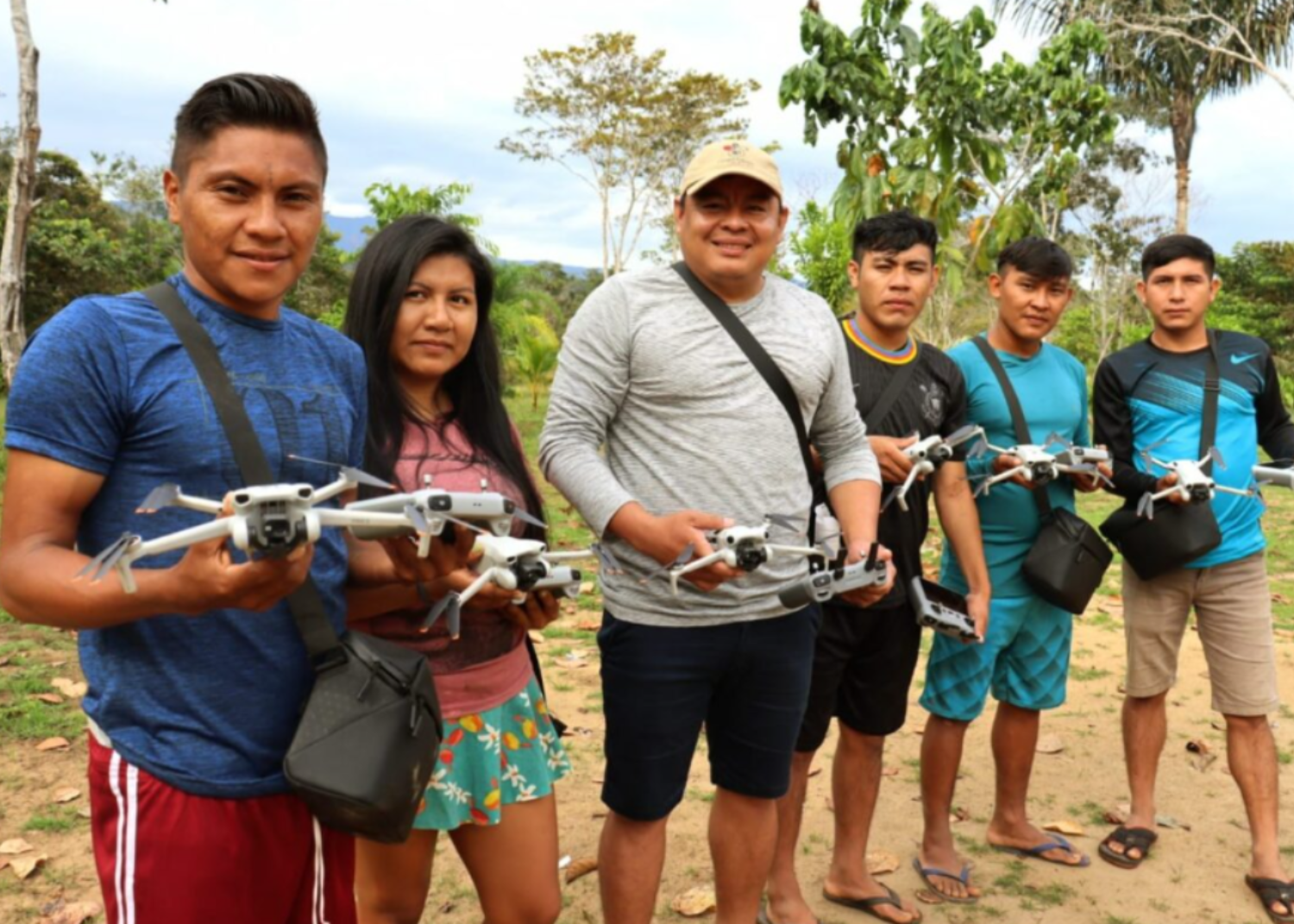
Indigenous youth use drones and other technologies to monitor their territories. Image courtesy of Evilene Paixão/HAY.
OURF has developed and is now implementing a program called R.O.C.K.E.T. (Rainforest Orangutan Conservation Knowledge and Education with Technology) in collaboration with Lord of the Trees that is dedicated to empowering students with cutting-edge knowledge and skills to leverage technology for the conservation and protection of orangutans and other species by incorporating AI, drones, and other advanced technologies to revolutionize how conservationists monitor and protect wildlife. This unique scholarship initiative is designed for select students within the Orangutan Caring Scholarship program, engaging them in multi-year projects that align with OURF's mission.
Bibliography
American Society of Primatologists. 2026. Artificial Intelligence for Primate Care and Research. https://asp.org/2025/08/13/ai-for-primate-care-and-research/
Bain, M., Negroni, A., Schofield, D., et al. 2021. Automated audiovisual behavior recognition in wild primates. https://www.science.org/doi/full/10.1126/sciadv.abi4883
Baisas, L. 2024. Orangutans’ distinct yells decoded with help from AI. https://www.popsci.com/environment/orangutan-communication-ai/#:~:text=While%20scientists%20may%20not%20have,the%20journal%20PeerJ%20Life%20&%20Environment.
Fonseca, M. 2025. Primatology goes high tech — from bioacoustics to drones & AI. https://news.mongabay.com/2025/10/primatology-goes-high-tech-from-bioacoustics-to-drones-ai
Gammelgard, F., et al. 2024. Application of Machine Learning for Automating Behavioral Tracking of Captive Bornean Orangutans (Pongo Pygmaeus). https://www.mdpi.com/2076-2615/14/12/1729#:~:text=The%20enclosure%20provided%20the%20orangutans,in%20the%20orangutans'%20enclosure%20daily.
Garcia Almeida, D. 2025. Tech alone won’t stop poaching, but it’s changing how rangers work. https://news.mongabay.com/2025/12/tech-alone-wont-stop-poaching-but-its-changing-how-rangers-work/
Kindangor, A. 2025. Real-time deforestation alerts get an AI boost to identify the causes. https://news.mongabay.com/2025/12/real-time-deforestation-alerts-get-an-ai-boost-to-identify-the-causes/
Kindangor, A. 2026. Democratizing AI for conservation: Interview with Ai2’s Ted Schmitt and Patrick Beukema. https://news.mongabay.com/2026/01/democratizing-ai-for-conservation-interview-with-ai2s-ted-schmitt-and-patrick-beukema/
Mpaka, C. 2025. As apes adapt to human disturbance, their new behaviors also put them at risk: Study. https://news.mongabay.com/2025/03/as-apes-adapt-to-human-disturbance-their-new-behaviors-also-put-them-at-risk-study/
Rainforest Connection, 2026. About Us. https://rfcx.org/
Raman, S. 2025. AI system eavesdrops on elephants to prevent deadly encounters in India. https://news.mongabay.com/2025/10/ai-system-eavesdrops-on-elephants-to-prevent-deadly-encounters-in-india/
Sabillo, K. 2025. ‘Satellites for Biodiversity’ upgrades with new projects and launches insight hub. https://news.mongabay.com/short-article/2025/05/satellites-for-biodiversity-upgrades-with-new-projects-and-launches-insight-hub/
Schofield, D., Albery, G., Firth, J., et al. 2023. Automated face recognition using deep neural networks produces robust primate social networks and sociality measures. https://besjournals.onlinelibrary.wiley.com/doi/full/10.1111/2041-210X.14181
Steen, M., De Bruyn, M. 2026. AI-centered conservation efforts can only be ethical if Indigenous people help lead them (commentary). https://news.mongabay.com/2026/01/ai-centered-conservation-efforts-can-only-be-ethical-if-indigenous-people-help-lead-them-commentary/
Sumantran Orangutan Society. 2026. AI can count orangutan nests 30x faster than humans. https://www.orangutans-sos.org/ai-can-count-orangutan-nests-30x-faster-than-humans/#:~:text=AI%20can%20count%20orangutan%20nests,habitats%20faster%20than%20ever%20before.
University of Oxford. 2021. Artificial intelligence used to recognise primate behaviours in the wild. https://www.ox.ac.uk/news/2021-11-17-artificial-intelligence-used-recognise-primate-behaviours-wild
World Wide Fund - Malaysia. 2023. Harnessing the Power of AI for the Future of Orangutans. https://www.wwf.org.my/?31705/Harnessing-the-Power-of-AI-for-the-Future-of-Orangutans#:~:text=If%20AI%20technology%20can%20take,currently%20working%20on%20the%20project.
Article prepared by Todd Cravens, OURF volunteer